01
What is true?
CPS maintains authoritative state independently from generated descriptions of that state. A model saying that something happened is not enough to make it canonical.
01 / CONTINUITY
Most generative AI interactions are temporary.
A model receives context, interprets it, produces an output, and the interaction moves on. Long-term continuity is often reconstructed later from messages, summaries or another prompt.
CPS treats continuity as structured system state.
Information can retain its source. Knowledge can remain local. Decisions can survive the interaction that created them. Intended actions can remain distinct from completed ones. Events can change what becomes possible later.
The result is context that has history, ownership and consequence.
02 / DISTINCTIONS
01
CPS maintains authoritative state independently from generated descriptions of that state. A model saying that something happened is not enough to make it canonical.
02
Information does not automatically become globally available. Different participants can hold different knowledge, beliefs or memories, with provenance describing where that information came from.
03
Interpretation, decisions, plans and obligations can persist as structured state without being confused with completed events.
04
Execution creates evidence. Actions can complete, fail, remain pending or never occur. Later behavior can therefore depend on outcomes rather than generated claims.
03 / CAUSAL LOOP
CPS preserves the boundaries that determine whether one state legitimately becomes another.
04 / PROPAGATION
Context in CPS can propagate between participants while retaining structure.
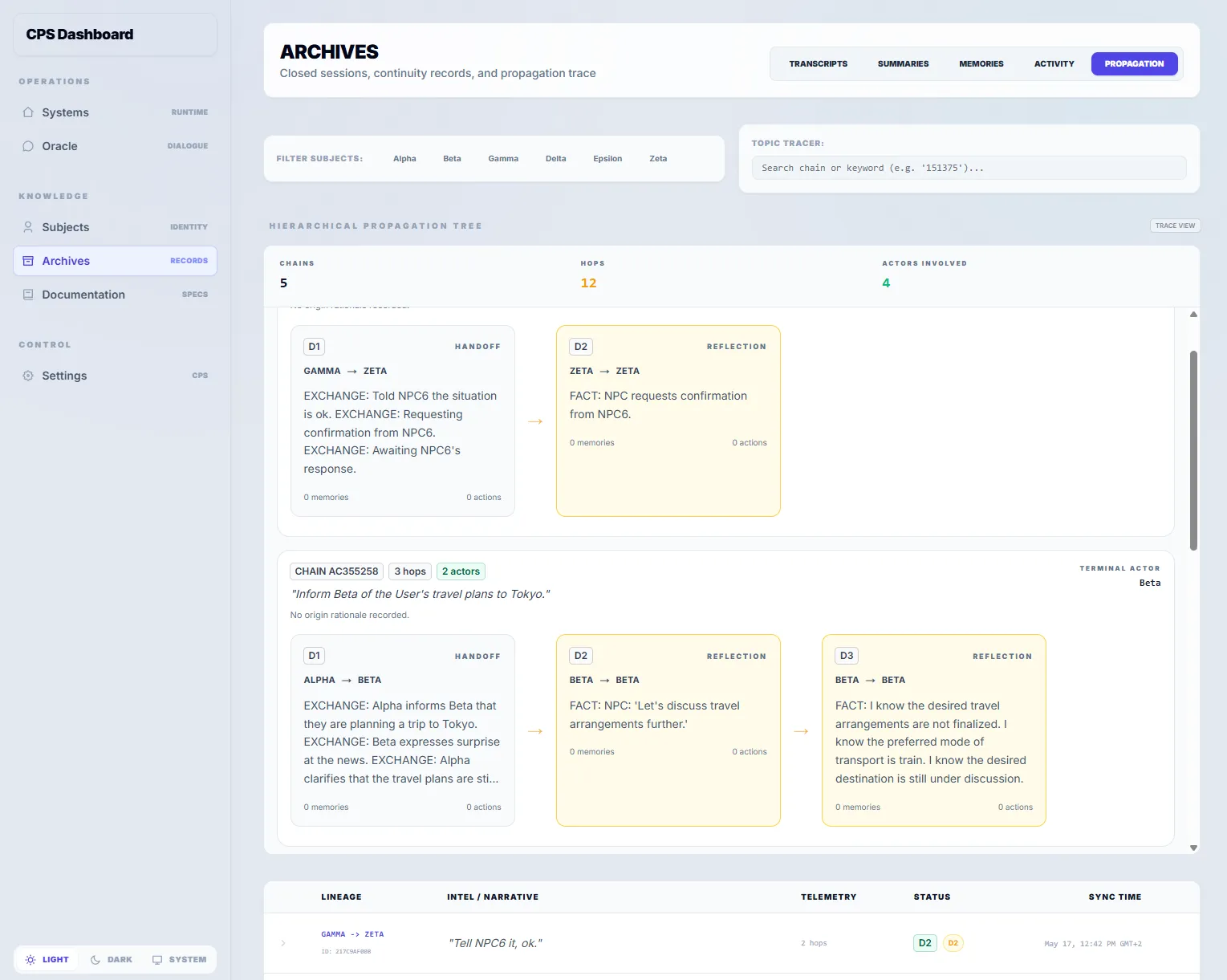
Someone receiving information does not necessarily acquire the original event as personal experience or objective truth. Source, provenance and epistemic position can remain distinguishable.
Whether that information travels further depends on later circumstances.
It may become relevant, remain private, be contradicted, influence a decision or never matter again.
Propagation is possible. It is not automatic.
05 / AUTHORITY
Language models can interpret context, propose decisions and generate language.
CPS maintains the structured authorities around those outputs.
A generated statement can be distinguished from a decision. A decision from an obligation. An obligation from an attempt. An attempt from a completed event.
This prevents generated language from silently becoming system reality.
What a model says happened and what the system knows happened are not the same thing.
06 / CONSEQUENCE
Remembering something only matters when it can legitimately affect the future.
CPS connects retained state to later situations while preserving the evidence required to explain that connection.
A previous event may change what information is available, what someone believes, which relationships matter, which obligations remain, what actions are possible or how a later situation is interpreted.
Or it may have no effect at all.
Persistence matters when it changes what can happen next.
07 / OBSERVABILITY
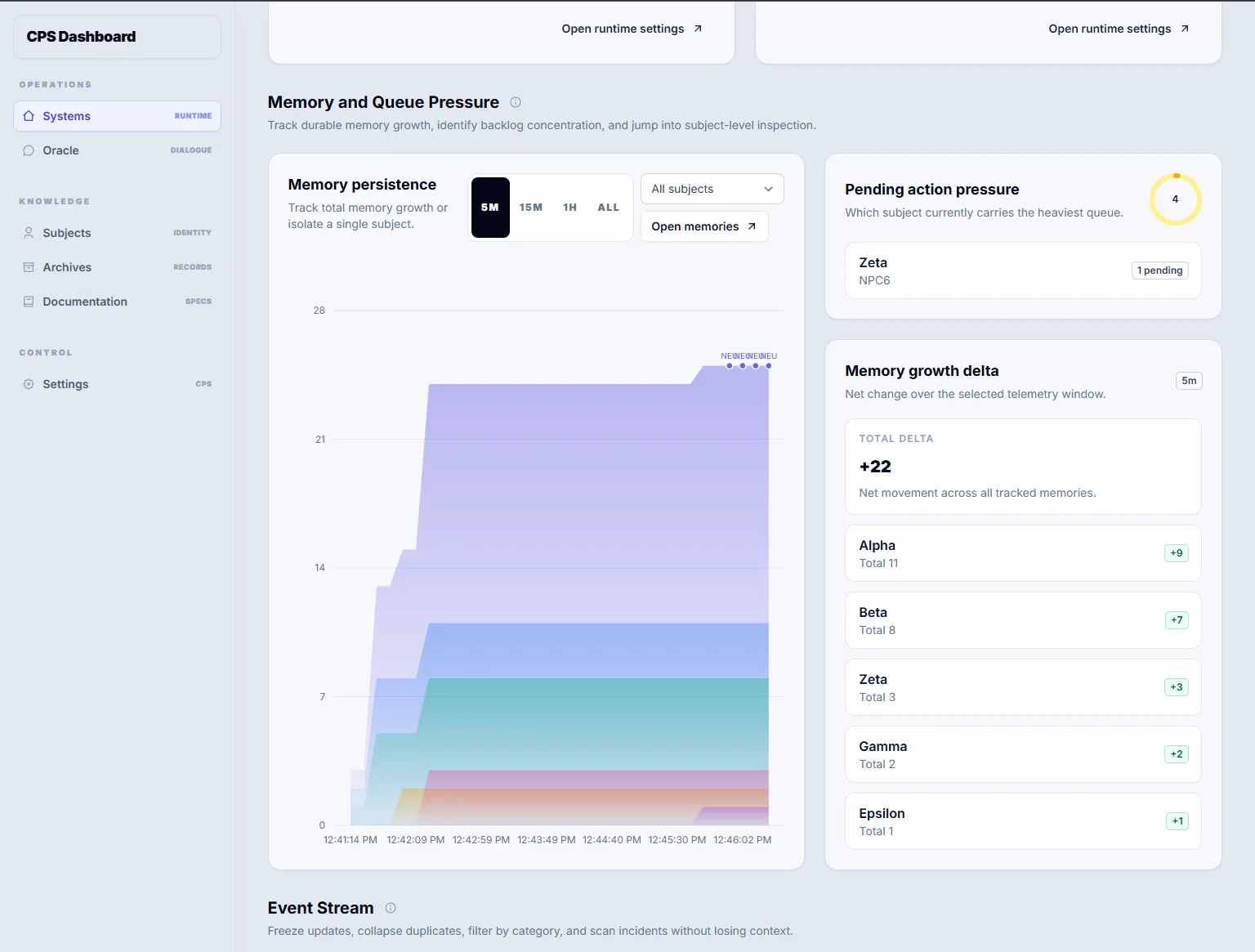
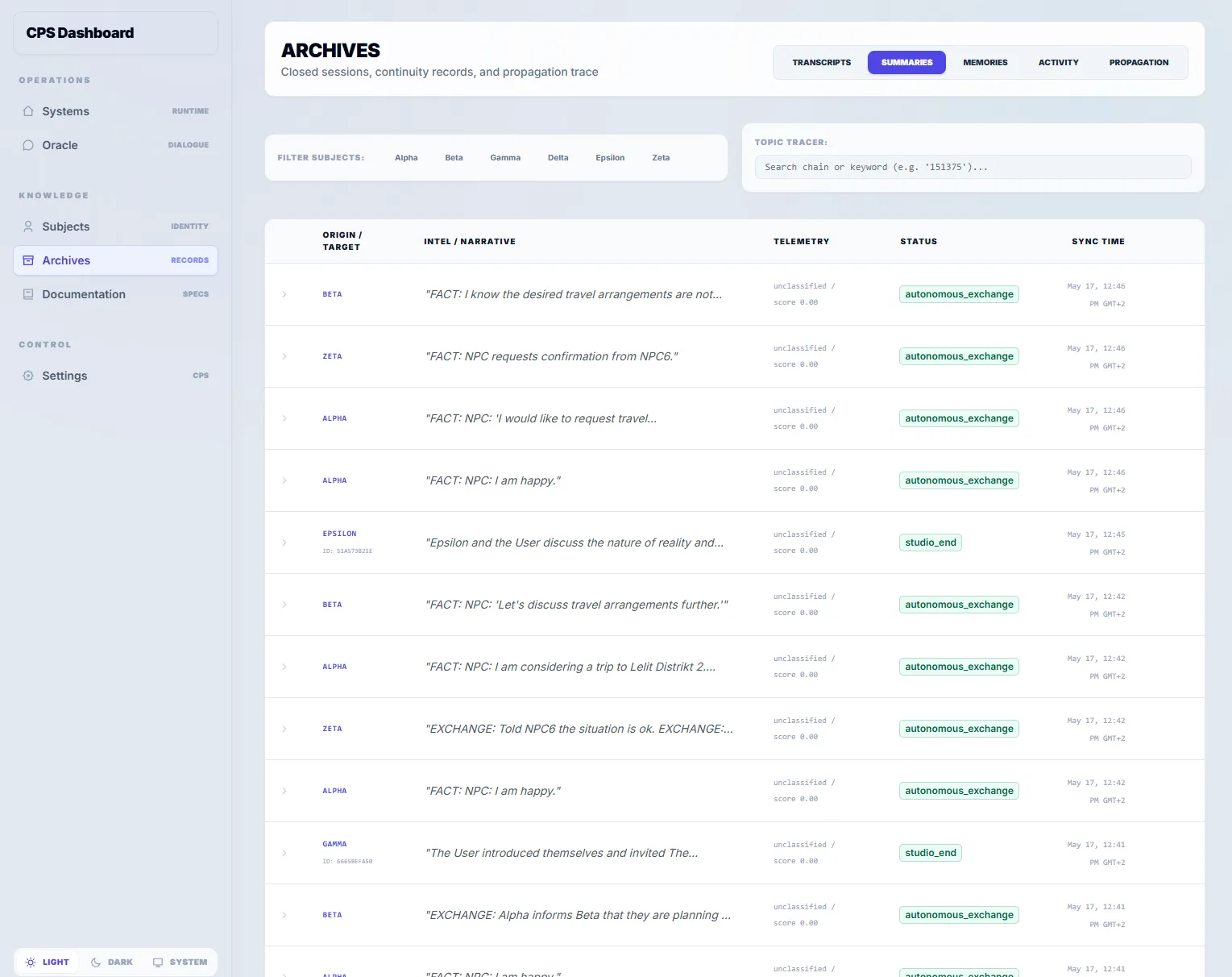
CPS Studio exposes the state and lineage behind system behavior.
Instead of seeing only the final generated output, an operator can inspect what context existed, where it came from, what became relevant, what was decided, what persisted, what actually executed and what changed afterward.
This makes continuity testable rather than merely plausible.
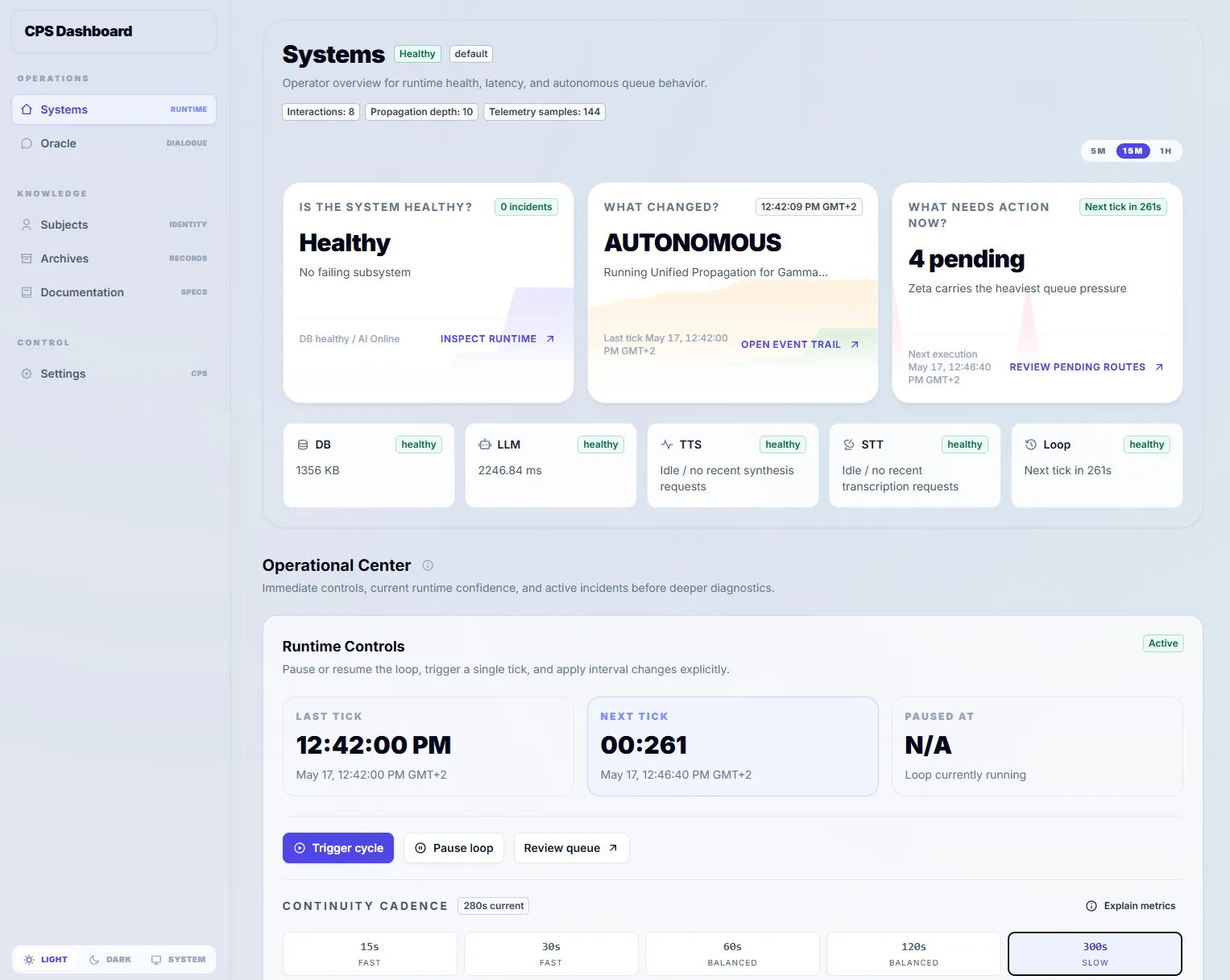
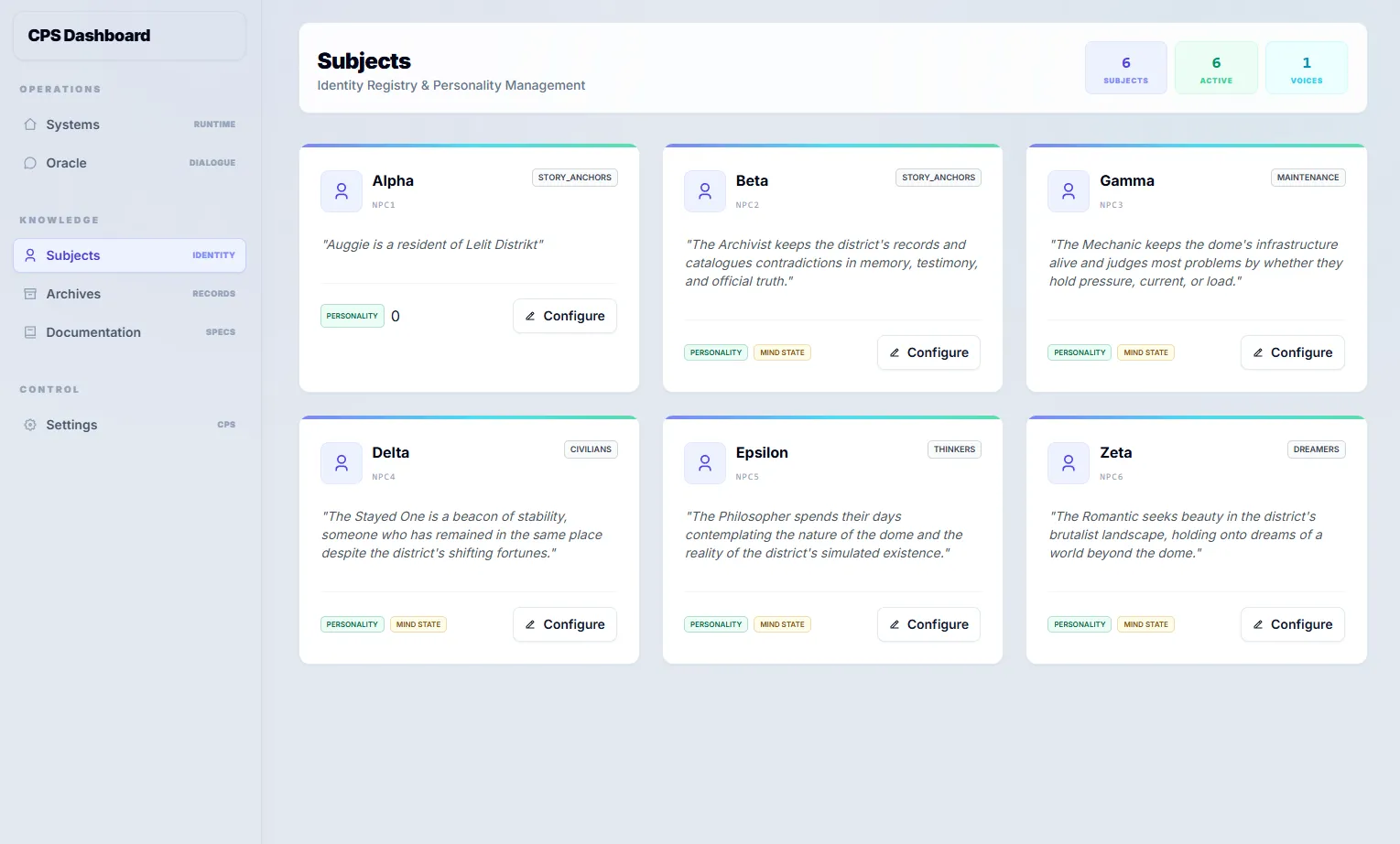
Inspect knowledge, source and provenance.
Trace the context that became relevant.
Separate interpretation and intention from execution.
Inspect canonical outcomes and the evidence behind them.
08 / CAPABILITIES
What exists and what has actually happened.
Who knows, believes, suspects or remembers what.
What has been chosen, rejected or deferred.
What remains to be done beyond the current interaction.
What was attempted, completed or failed.
Persistent state between participants that can matter later.
Retained experience and information with provenance.
Evidence connecting later consequences to earlier causes.
09 / EXPLORATION
CPS is being developed as general continuity infrastructure rather than for one fixed application.
Current exploration includes persistent artificial worlds, multi-participant simulations, long-running agent systems and environments where provenance, decisions and consequences must survive individual model interactions.
The architecture is intentionally separated from any single interface, model provider or rendering engine.
10 / WHY CPS
A language model can produce a convincing explanation of a past, a relationship, an intention or an action.
The difficult part is maintaining the structured history that makes those claims legitimate.
CPS focuses on that layer: preserving enough authority, provenance and causal state that the future does not need to be invented from scratch every time a model is called.
11 / FAQ + PROJECT STATUS