Project Summary

CPS at a glance

Context Propagation System is an exploratory continuity and social-memory infrastructure for artificial worlds. It is designed for projects where information should not vanish after a conversation, but persist as structured memory, move through a group, mutate through perspective, remain private when needed, and later return as consequence.

CPS is not framed as a disposable chat feature, a full society simulator, or a foundation model effort. It is a bounded prototype for making memory, propagation, lineage, and inspectability operational.

Why It Exists

The problem CPS focuses on

Most AI interactions still behave like isolated exchanges. They produce an answer, then the broader social consequence either disappears or remains opaque. CPS focuses on the continuity layer that appears once systems begin to retain state over time and across agents.

  • How does information persist after the originating conversation?
  • Who is allowed to know something, and under what constraints?
  • How does recall change as information passes through trust, bias, fear, privacy, and rumor?
  • How can a creator inspect why a later reaction happened?
CPS treats continuity as design material: memory has source, ownership, confidence, privacy boundaries, lineage, and effect.

How It Works

Four-layer operating model

01

Interaction layer

Conversations, events, and observations enter through a world, a tool, or another interface.

02

Continuity layer

CPS turns moments into structured memory with source, ownership, confidence, emotional weight, privacy, and history.

03

Propagation layer

Information can move through social links instead of global broadcast logic, with containment rules, duplication control, and mutation over time.

04

Observability layer

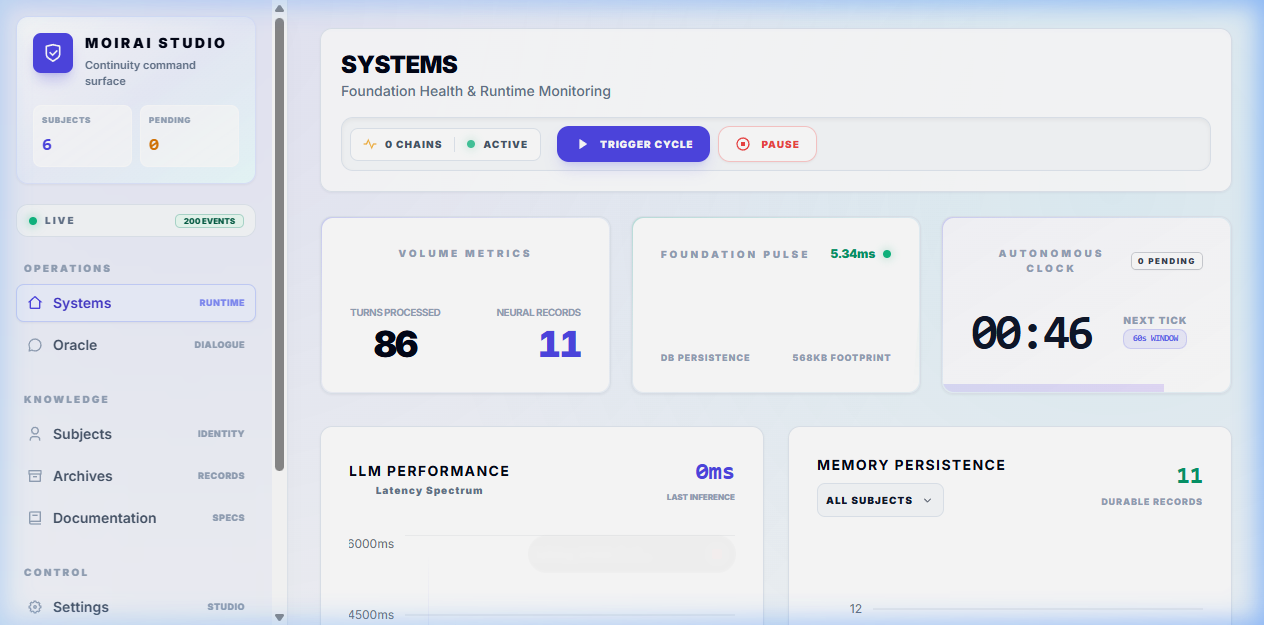
CPS Studio exposes memory lineage, propagation depth, recall state, and system behavior so continuity does not become a black box.

What Makes It Distinct

Three operating pillars

Durable memory records

Dialogue is distilled into lasting records for facts, identities, preferences, and narrative state.

Controlled propagation

Memories move through relationship-shaped routes, not flat omniscient sharing, and can be inspected for mutation and containment.

Authenticity guardrails

Characters remain constrained by authored identity, expertise, and situation rather than defaulting to assistant-like behavior.

Structured authority

Language models interpret and reformulate, but CPS owns the underlying social-memory state and continuity rules.

Project Shape

What CPS is and is not

  • It is a continuity and propagation layer for authored artificial environments.
  • It is not primarily a game mechanic, even though it can live inside game-like worlds.
  • It is not a claim to full-society simulation at the current stage.
  • It is not dependent on a single model provider or model family.
  • It is being built as an inspectable instrument for bounded proofs, not as an opaque memory feature.
CPS Studio overview showing project observability views.
CPS Studio overview / public screenshot

Use Cases

Where the system can matter

The site frames CPS as a reusable layer rather than a single fixed story world. The strongest current use case is a bounded authored environment where a small number of agents can demonstrate continuity clearly, but the same logic can support wider applications.

Interactive worlds

Characters can remember, misremember, protect, or circulate information in ways that shape later scenes.

Research prototypes

Bounded systems can be used to inspect rumor flow, trust dynamics, privacy, recall quality, and information drift.

Cultural installations

Visitors can enter staged social environments where their interactions affect what the world later remembers and reveals.

Human-agent studies

Future embodied AI contexts will require accountable social memory, not only task execution and dialogue fluency.

Current Endpoint

Lelit Distrikt and CPS Studio

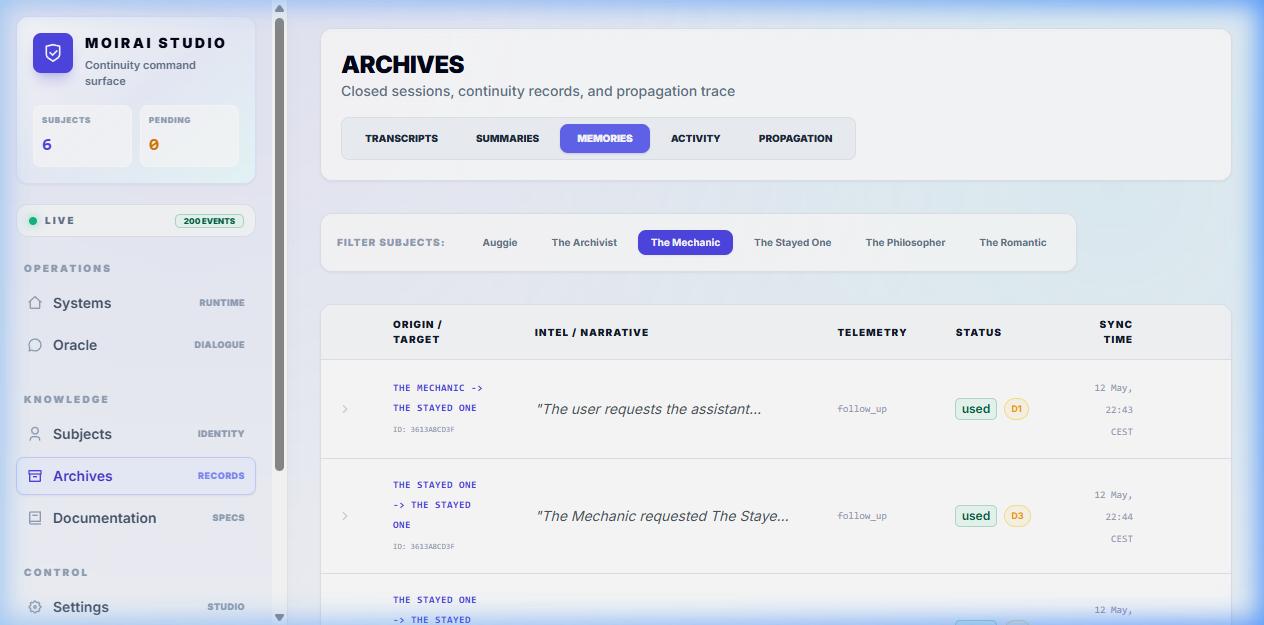
Lelit Distrikt is the first visual endpoint built around CPS. It gives the system a bounded district where the afterlife of conversation becomes emotionally legible. CPS Studio is the complementary control and inspection surface used to observe what memories exist, how they spread, and whether the system behaved as intended.

CPS Studio memories view showing archived narrative memory records.
Memories view / public screenshot

Current Direction

Designing artificial worlds where information has consequences

The project direction is deliberately narrow and strategic: create bounded, observable systems where social memory can be introduced, constrained, traced, and understood. That makes CPS useful for creators, researchers, and institutions interested in continuity, inspectability, memory boundaries, and the social behavior of information inside artificial groups.